


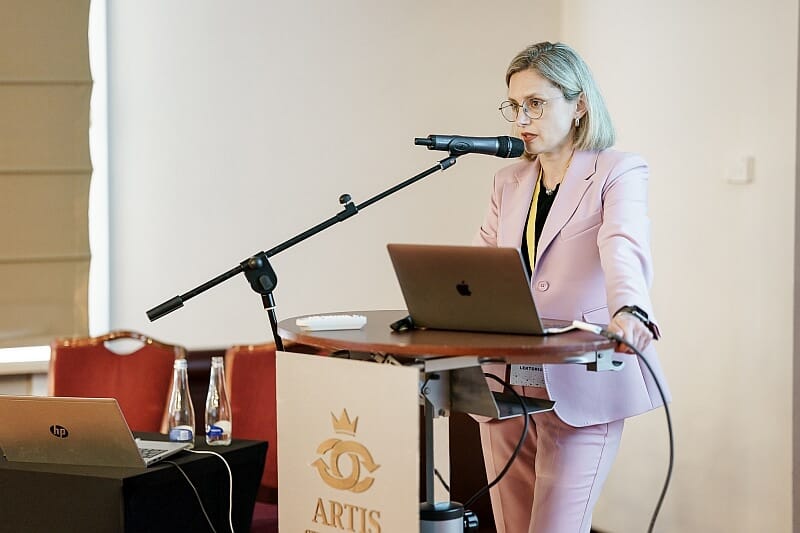
Even in childhood, she had to deal with frequent middle ear infections (otitis media), an experience that later blossomed into a deep passion for otoneurology and ear surgery. Specialising in ear diseases, the doctor shares her personal story, explains the causes of ear conditions, treatment methods, and the latest surgical technologies, while also offering helpful advice for those experiencing dizziness, hearing loss or tinnitus.
Childhood experiences that led to becoming a doctor
“Throughout my childhood, I suffered from earache – I belonged to that group of children who had recurrent middle ear infections. A typical situation from my childhood: we fly to the seaside, my ear starts hurting severely on the plane, and once we land, it starts to discharge,” says Dr I. Arechvo.
She notes that she remembers the unpleasant earache very well, which is why now, as a doctor, she always tries to examine the ear canal and eardrum extremely gently. This is especially true for patients who had recurrent ear infections in childhood and are therefore highly sensitive to any ear examinations or procedures.
Why do children get recurrent ear infections more often?
Recurrent middle ear infections (otitis media) in childhood are a common occurrence, linked to specific anatomical and functional features of the Eustachian tube and the skull base. According to scientific research, they affect between a quarter and a half of children under the age of ten.
“Children’s ears are anatomically not yet as mature as those of adults,” explains the ENT specialist. “Because of this, fluid is more likely to build up behind the eardrum, pressure is harder to equalise, and every cold can lead to an ear infection.”
One of the main reasons is the structure of the Eustachian tube. In children, the Eustachian tube is shorter, narrower and more horizontal, making it harder for air to reach the middle ear and for accumulated fluid to drain. Additionally, a child’s nasopharynx is still small and often obstructed by enlarged adenoids, which further hinders middle ear ventilation and leads to fluid stagnation.
According to Dr I. Arechvo, when the mucosal lining in the tympanic cavity is swollen, it becomes difficult for children to equalise negative pressure. This is precisely why even a mild cold can cause a middle ear infection or temporary hearing loss.
In recent years, with the advancement of endoscopic ear surgery, medical professionals have been paying increasing attention to the ventilation pathways of the tympanic cavity itself. “Today in otology, particular emphasis is placed on the importance of middle ear ventilation – not only for hearing, but also for preventing infections,” the doctor highlights.
During surgical treatment, swollen mucosal folds around the ossicles are removed, thereby improving airflow distribution within the tympanic cavity. This allows air to pass more easily from the anterior to the posterior parts of the cavity, preventing retracted areas of the eardrum – known as retraction pockets – from progressing into a dangerous condition called cholesteatoma (an accumulation of keratinising stratified squamous epithelium, or skin, within the middle ear and the pneumatised structures of the temporal bone).
“Endoscopic surgery allows for a more precise restoration of physiological ventilation and reduces the risk of infection progression,” says Dr Irina Arechvo.
Grommets (tympanostomy tubes): a quick solution for children and adults
“I was one of those children who, due to fluid building up behind the eardrums, spent several months of the year struggling to hear,” recalls the ENT specialist. Her childhood experience is not an isolated case. This condition, where fluid accumulates behind the eardrum without signs of an active, suppurative infection, is known as otitis media with effusion (OME), or glue ear. It is one of the most common causes of hearing loss in children.
“Nowadays, we can help these children quickly and effectively by inserting a grommet, draining the fluid, and restoring their hearing,” the doctor explains. This procedure is performed under general anaesthetic, takes only a few minutes, and the results are immediate – the patient’s hearing improves straight away.
The grommet remains in the ear for as long as necessary for the middle ear lining to return to normal – from a few months to several years. The procedure is not limited to children; according to the doctor, this operation is sometimes performed on adults, and almost always achieves a good functional outcome.
However, Dr I. Arechvo emphasises that any surgical treatment should only be considered once all conservative options, which are plentiful nowadays, have been exhausted.
Ear infections in childhood can lead to serious consequences
Recurrent childhood ear infections do not always resolve without consequences. They can cause mucosal swelling and scarring in the middle ear, and some patients go on to develop chronic otitis media (chronic middle ear infection). This condition presents with persistent or recurrent discharge from the ear due to a perforated eardrum, along with hearing loss and tinnitus caused by damaged ossicles.
According to the doctor, in some cases, a relatively dangerous condition called cholesteatoma can develop. “This is a destructive disease which, if left untreated, can cause facial nerve palsy, damage to the vestibular organ (the balance system), meningitis, or even brain abscesses,” warns Dr I. Arechvo.
Ear surgery – a complex and precise field of otolaryngology
“I fell in love with ear surgery from my first day of specialist training, when I first saw a microscopic stapedoplasty,” says the ENT specialist. Admittedly, she observed the first operation upside down because she did not yet know how to work with the microscope. According to her, this skill requires time and effort.
Since then, ear surgery has become one of the doctor’s greatest professional passions. It is a highly complex and precise field of otolaryngology. “The facial nerve, which supplies the facial muscles, passes through a middle ear space of just a few cubic millimetres – damaging it can cause facial palsy. The vestibular organ and the semicircular canals, which are responsible for balance, are also located there – damage to them causes severe vertigo. Furthermore, the nerve responsible for taste – the chorda tympani – runs right through the middle of the surgical field, and, most importantly, there is the highly delicate sound transmission system,” she explains.
This system consists of the geometrically complex eardrum and a perfectly matched chain of three auditory ossicles (hearing bones), connected by two tiny joints. Thanks to modern technology, these mechanisms can be reconstructed with extreme precision using titanium or platinum prostheses, even those with integrated joints.
“When an ENT specialist sees a mixed or conductive hearing loss on an audiogram – where there is a gap between the two curves (an air-bone gap) – an ear surgeon can, in most cases, improve the sound conduction mechanism,” the ENT specialist emphasises.
The doctor’s dedication to this field continued during her PhD studies at the Technical University of Dresden, where she spent several years working in a temporal bone dissection laboratory – a facility considered the gold standard for learning ear anatomy.
“Almost every day, I conducted biomechanics experiments, working alongside experienced sound engineers and some of the best surgeons in Germany. I had truly outstanding mentors. Among them was my PhD supervisor, Prof. Thomas Zahnert, one of the global leaders in ear surgery. We still keep in touch with the professor, meeting at scientific congresses and constantly exchanging knowledge,” Dr I. Arechvo says with satisfaction.
Modern ear surgery: maximum precision through minimal invasion
“Like my colleagues in Europe, I perform the full range of otosurgical procedures,” says Dr Irina Arechvo.
The procedures performed by the doctor include myringoplasty (eardrum repair), tympanoplasty, ossiculoplasty (reconstruction of the hearing bones), stapedoplasty (hearing restoration for otosclerosis), removal of cholesteatoma, and treatment of complications caused by this disease. The experienced specialist also performs closure of semicircular canal defects, as well as skull base and cerebrospinal fluid (CSF) leak reconstructions.
“It is reassuring that complicated cases of otitis media are less common in the era of antibiotics, though we still have to treat them,” the doctor notes.
The endoscope replaces the microscope
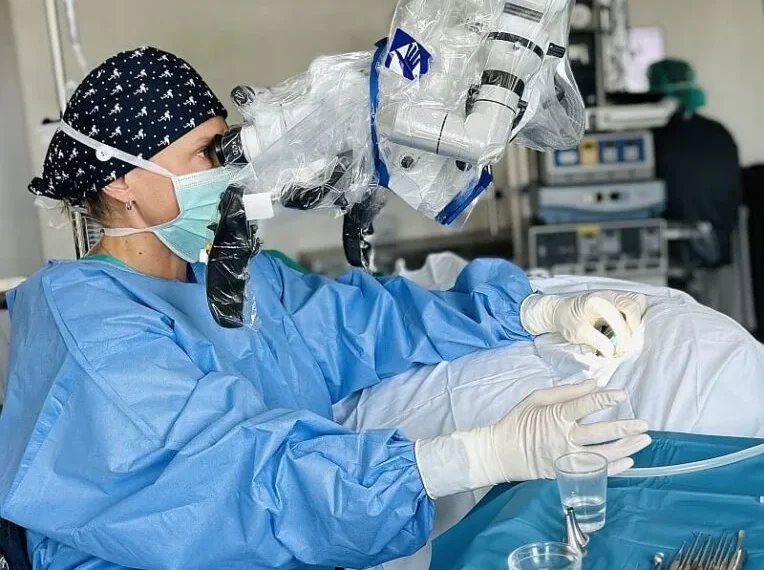
For many years, the ENT specialist performed ear surgeries using a microscope, but recently she has adopted an advanced, minimally invasive, fully endoscopic surgical technique in her practice. According to the experienced specialist, this is a major breakthrough in the field.
“The endoscopic technique provides excellent visualisation of anatomical structures and pathological changes. It helps to precisely reconstruct the middle ear ventilation mechanisms and, in many cases, avoids the need for a post-auricular incision (an incision behind the ear),” explains Dr I. Arechvo.
Investing in quality for the benefit of patients
The ENT specialist is pleased to have the opportunity to work with state-of-the-art equipment: “I am very pleased that the Baltic-American Clinic invests in the highest quality surgical instruments.”
According to her, in ear surgery, as in any other field, excellent visualisation and precision are paramount. Otosurgery requires meticulous care, as it involves constantly checking the hidden recesses of the temporal bone and removing any pathological disease from them.
Since the procedures are performed through a natural opening – the external auditory canal – all instruments used must be extremely precise and compact. “Dissectors, micro-needles, suction devices – everything has to fit through that narrow passage,” the specialist explains.
Modern angled endoscopes make it possible to reach even the most inaccessible parts of the ear without disrupting natural anatomical structures. This is crucial not only for clinical effectiveness but also for ensuring maximum patient safety.
Dizziness – a common but not always harmless symptom
How is dizziness related to ear surgery? According to the ENT specialist, this question often arises not only for patients but also for some healthcare professionals: “The temporal bone and the lateral skull base form one of the most complex anatomical regions in the head – and it is precisely where the hearing and balance organs are closely linked.”
For this reason, in the US, for example, after completing a five-year residency in general ENT, some doctors choose a further two-year fellowship in otology and neurotology (otoneurology). Such specialists not only operate on complex brain tumours, such as vestibular schwannomas, but also have an in-depth understanding of the diagnosis and treatment of dizziness.
“As otologists-otoneurologists, we are fully equipped to treat conditions such as benign paroxysmal positional vertigo (BPPV) – which is one of the main causes of vertigo – Ménière’s disease, vestibular neuronitis, and functional dizziness. We are also able to accurately differentiate between peripheral vertigo, which originates from ear disorders, and central vertigo, which is caused by brain pathologies,” says Dr Arechvo.
Comprehensive diagnosis and rapid treatment
According to the doctor, some patients do experience dizziness due to acute or chronic ear infections. “This is always a serious complaint that requires a thorough investigation,” she emphasises.
Advanced diagnostic methods are used: computerised Frenzel video goggles, videonystagmography (VNG) equipment to accurately assess eye movements in the dark, and the Video Head Impulse Test (vHIT), which evaluates the function of each semicircular canal of the inner ear labyrinth.
When should you consult an otoneurologist?
If you experience vertigo (a spinning sensation) when turning over in bed, getting up in the morning, bending down to tie your shoelaces, or looking upwards, Dr I. Arechvo advises not to delay: “In such cases, it is definitely worth seeing an otoneurologist.”
One of the most common causes of this type of positional vertigo is tiny calcium crystals moving within the inner ear labyrinth. The good news is that it usually takes an experienced clinician just a few minutes to treat you.
“Otoneurologists are quite unconventional doctors. We usually prescribe medication only for a short time during the acute stage of the illness, but we place a heavy emphasis on specific balance exercises. We not only explain their importance but also teach patients how to perform them correctly,” the specialist highlights.
Tinnitus – a challenge for patients and doctors
Another common and highly distressing symptom for which patients seek help from an otoneurologist is tinnitus (ringing in the ears). This is a widespread issue, affecting nearly one in seven people worldwide at some point in their lives.
“Before surgery, patients often ask me whether their tinnitus will improve,” says the ENT specialist. “Unfortunately, in our practice, we cannot always give a definitive answer, but there is one universal rule: anything that improves hearing – whether it is surgery or a hearing aid – usually helps to reduce tinnitus as well.”
According to the specialist, the rest of the outcome depends on individual neurophysiological processes in the brain, the person’s psychological state, and their personality traits.
Armed with a wealth of knowledge and international experience, and utilising modern technology, Dr Irina Arechvo helps patients find relief from distressing symptoms and reclaim their quality of life. “Every time I see a patient’s hearing improve or their vertigo resolve, I am glad that I chose this specialty,” says the ENT specialist Dr Irina Arechvo, concluding the conversation.